

After infidelity, the most useful questions are what agreement was broken, what you need now and whether you want to continue the relationship. You do not have to solve those questions by guessing why an entire group of people cheats.
Clear information and room to choose matter more than stereotypes, pressure to forgive or a promise that an affair will somehow improve a relationship.

Start with the agreement that was broken
Infidelity involves a breach of the relationship agreements people have made. Those agreements may concern sex, romantic involvement, private messages or secrecy. Different couples draw different boundaries, so a useful first question is what you had both understood and agreed.
A consensually non-monogamous relationship can have broken agreements too. Neither a relationship label nor an assumption that “everyone does it” replaces clear, freely chosen consent. If a boundary was unclear, discuss it honestly; that uncertainty does not excuse deliberate deception.
Avoid shortcuts about who cheats
Music taste, gender, a menstrual cycle or an outgoing personality cannot tell you whether a particular partner is faithful. Treating these as tests can turn ordinary behaviour into suspicion while overlooking actual dishonesty.
Focus on what you know: an admitted breach, a specific inconsistency or a boundary that has been ignored. You can ask direct questions without checking someone’s private accounts or turning friends into investigators. An unanswered concern is a reason to consider your boundaries, not proof of a hidden affair.
An explanation does not transfer responsibility
Someone may describe loneliness, opportunity, resentment or dissatisfaction when explaining an affair. You can listen without accepting blame for their decision. Concerns about the relationship could have been raised directly; secrecy was still their responsibility.
Likewise, being unhappy does not prove that someone will cheat, and appearing happy does not settle what happened. Ask about the specific conduct rather than trying to fit your partner into a type. You do not need a complete explanation before deciding what contact feels acceptable.
Attend to the practical questions first
You may want space before a long conversation. Consider where you can rest, whom you trust to listen and which shared tasks need a temporary arrangement. You can decline sex or physical affection while deciding what you want.
If there may have been an STI exposure, speak with a healthcare professional about appropriate testing and timing. The CDC’s STI testing guidance explains that infections can have no symptoms and that testing needs depend on individual circumstances. A partner’s reassurance alone does not answer a health question.
If you fear threats, intimidation or retaliation, get private support before confronting the person. The personal safety-planning guide can help you identify questions to discuss with a specialist.
If you are considering repair
Repair has to be a choice both people make. Look for honest answers, responsibility without blame, respect for your pace and follow-through on agreed boundaries. An apology or a promise to change does not by itself establish that trust has returned.
You might ask: “What has ended, what contact is still necessary, and how will we handle questions without pressure or evasion?” Agreeing to transparency does not require indefinite surveillance or surrendering all privacy. If you seek professional support, consider whether both of you can participate freely and safely.
Leaving remains an option
You do not owe reconciliation because the relationship lasted a long time, the person regrets it or others want you to stay. You may also need time to decide. Neither choice requires proving that your response is the only reasonable one.
For more reflection, read reasons you might choose to leave after infidelity. A useful next step today could be arranging a quiet place to think and writing down the two questions you need answered before another conversation.
Read the infographic in text
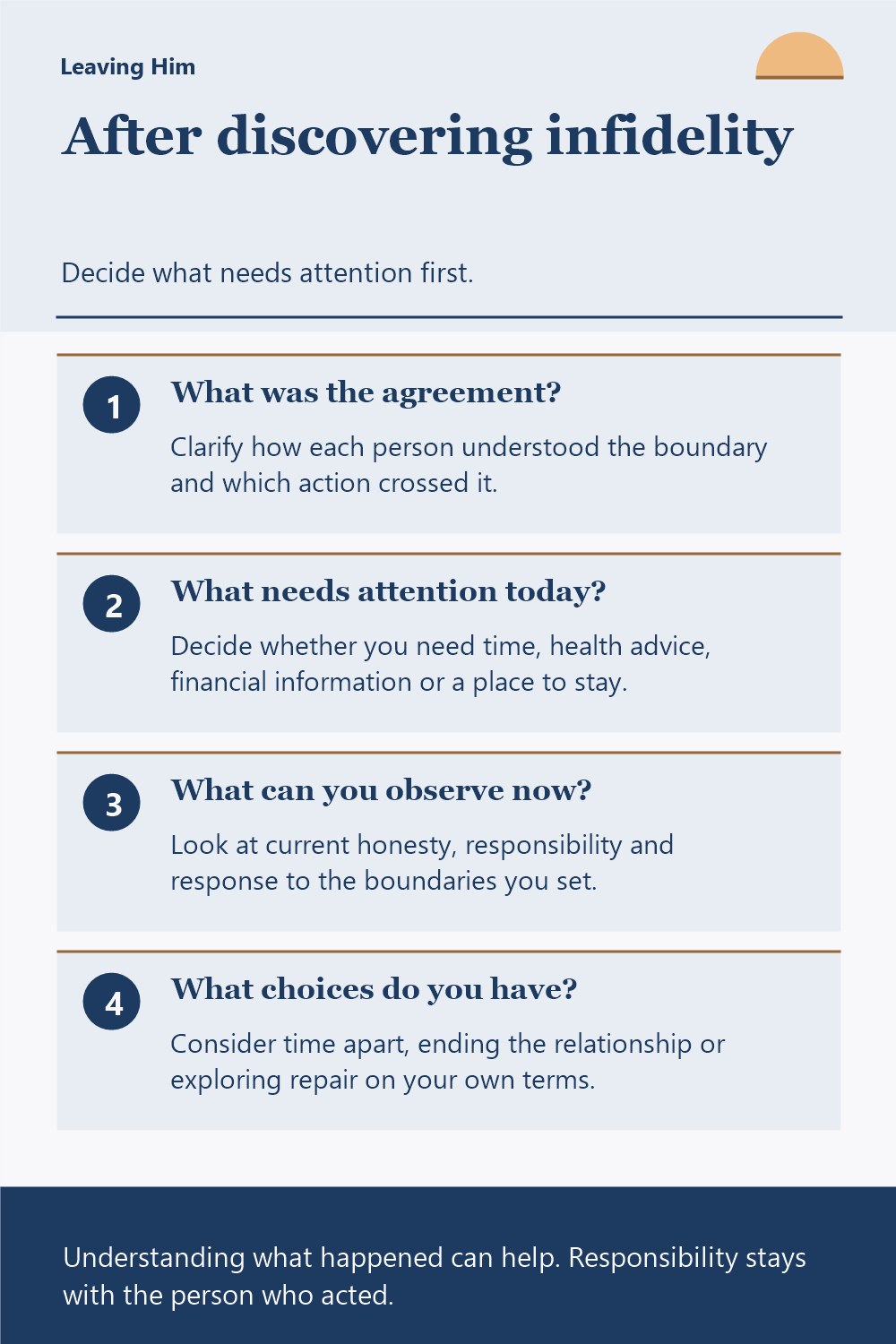
After discovering infidelity
Decide what needs attention first.
- What was the agreement? Clarify how each person understood the boundary and which action crossed it.
- What needs attention today? Decide whether you need time, health advice, financial information or a place to stay.
- What can you observe now? Look at current honesty, responsibility and response to the boundaries you set.
- What choices do you have? Consider time apart, ending the relationship or exploring repair on your own terms.
Understanding what happened can help. Responsibility stays with the person who acted.