

When your partner seems emotionally distant, the useful question is what happens between you and whether the relationship meets your needs. Gender, a quiet personality or a difficult conversation cannot explain an individual’s feelings for you.
You can ask for clarity without forcing disclosure, and you can set boundaries without deciding that the person has no emotions or needs to be fixed.

Describe the distance you are noticing
“Emotionally distant” can mean different things: important questions go unanswered, plans stay vague or conversations rarely include your concerns. Start with a specific example and how it affects the relationship.
A quiet or reserved person is not necessarily uncaring. You also do not have to dismiss your need for conversation because someone expresses themselves differently. Look at what the two of you can actually discuss and agree.
Ask for what would make the relationship workable
Try a concrete request: “When plans change, I need you to let me know,” or “Can we talk about what we each want from this relationship?” That gives the other person something clearer to respond to than a demand to open up about everything.
Notice the answer and follow-through. You can respect someone’s pace while deciding that an indefinite lack of clarity does not work for you.
Keep respect separate from emotional style
Difficulty talking about feelings does not excuse insults, humiliation or disregard for your boundaries. Likewise, an affectionate conversation does not cancel disrespectful behaviour elsewhere.
Consider whether you can disagree, decline a plan or raise a concern without being punished for it. How someone responds to an ordinary limit may matter more to your decision than how eloquently they describe their emotions.
Look for responsibility in the present
You do not need a full account of every previous relationship to assess what is happening now. Ask about a current problem and whether the person can acknowledge their part and discuss a practical change.
Someone may want privacy about an ex. That is different from blaming you for conduct they chose or repeatedly refusing to address an agreement between you. Focus on the pattern you can observe instead of trying to decide whether they are insecure.
Distinguish personal space from control
Time alone, separate interests and other friendships can belong in a caring relationship. You can discuss how much contact each of you wants without expecting constant availability.
Pressure to give up friends, surrender passwords or seek permission for ordinary choices is a different concern. If isolation, threats or monitoring are involved, seek private specialist support. The guide to control presented as love can help you name questions to discuss.
Do not treat sex as an agreement about commitment
Sexual contact does not establish what a person wants emotionally or whether you are exclusive. Gender does not tell you how attached someone will feel. Ask about the relationship rather than relying on a sexual encounter to settle the question.
You can decline sex, ask for different time together or decide that your expectations do not match. Neither person should have to provide physical affection to earn a conversation or keep the relationship.
Respect privacy without abandoning your needs
Someone can choose not to discuss a painful experience or private history. You do not need to press for a disclosure to prove closeness, and you are not entitled to a story that explains every reaction.
You can still ask about how you will handle present-day issues together. “You do not have to tell me that history, but I need us to discuss how we respond when plans change” keeps those questions separate.
Clarify what each person wants now
A long dating history does not guarantee readiness, and a short one does not prove that someone cannot commit. Ask about the present: the kind of connection wanted, the pace and any agreements that matter to you.
If the person says they do not want a relationship, take that seriously rather than waiting for enough affection to change the answer. If they remain vague, you can decide how much uncertainty you are willing to continue with.
Offer support without becoming responsible for change
You cannot infer trauma or a mental-health condition from reluctance to talk. If someone says they are struggling and wants support, ask what would be useful. Professional help can be an option they choose; it is not a role you have to take on as their partner.
Compassion and boundaries can coexist. You can care about someone while deciding you cannot continue the relationship as it is. Their progress does not have to become a condition you keep monitoring indefinitely.
Choose a next step you can control
You might ask one clear question, set a contact boundary or decide to leave. If you both want to continue, agree on a specific change and notice whether it happens. You do not need a diagnosis or a guarantee about the person’s future to make your own decision.
For further reflection, read considering patterns, repair and whether to break up. Your need for clarity deserves attention without making you responsible for another adult’s feelings.
Read the infographic in text
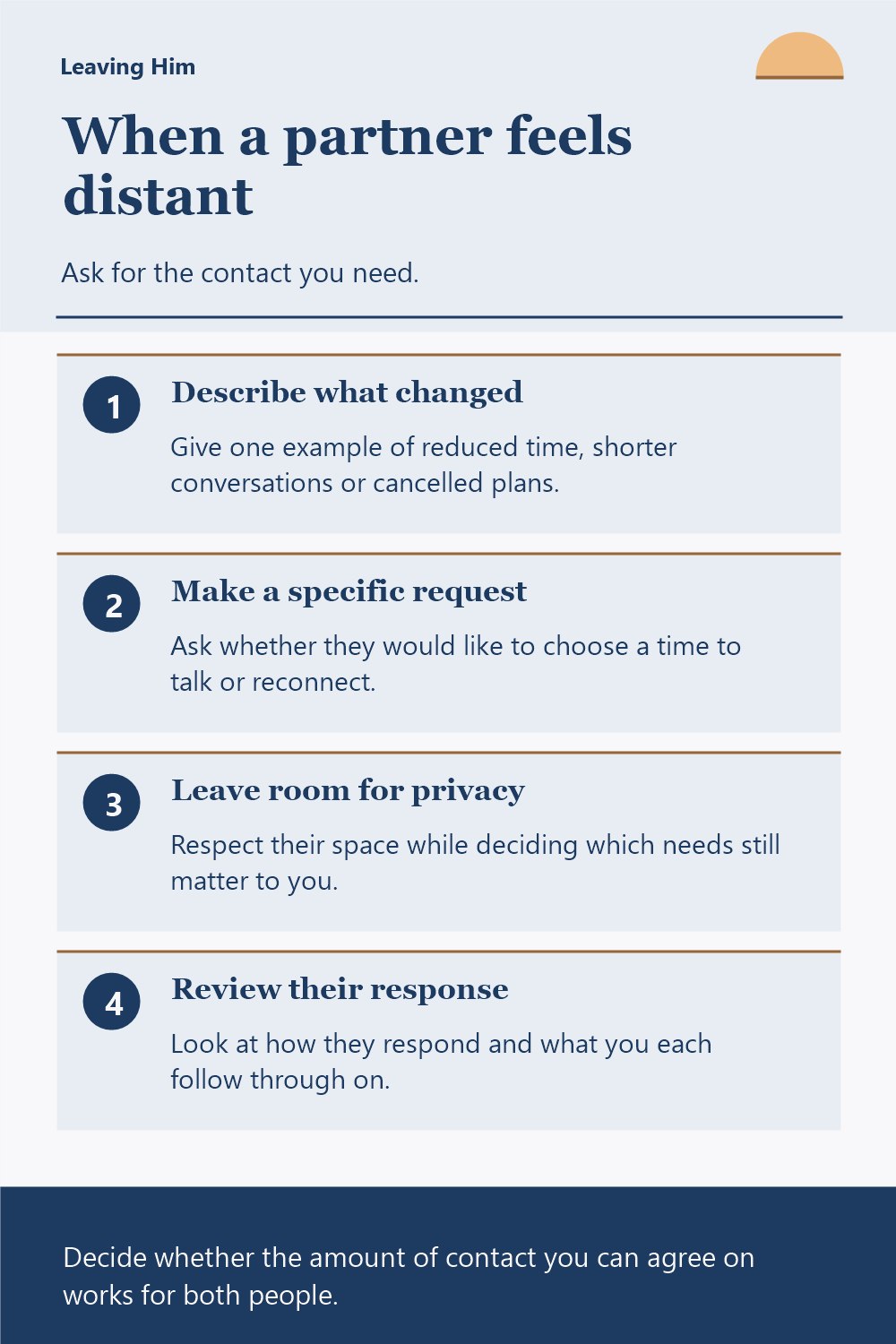
When a partner feels distant
Ask for the contact you need.
- Describe what changed Give one example of reduced time, shorter conversations or cancelled plans.
- Make a specific request Ask whether they would like to choose a time to talk or reconnect.
- Leave room for privacy Respect their space while deciding which needs still matter to you.
- Review their response Look at how they respond and what you each follow through on.
Decide whether the amount of contact you can agree on works for both people.