

Leaving a relationship when you have no money can raise immediate questions about a bed, transport, food, medication, children or pets. Those practical barriers deserve support; they do not measure your courage or your right to leave.
Start with the most urgent need and a safe way to ask about it. If there is abuse or controlling behavior, an individualized safety plan matters alongside financial planning. In immediate danger, seek local emergency help when you can do so safely.
Browse the practical steps
- Start with the most urgent need
- Choose a safer way to ask for help
- Ask a service what it can actually provide
- Separate today’s needs from later costs
- Check which resources are safely accessible
- Ask specific housing questions
- Collect information without risking your safety
- Include children and other care needs
- Explore benefits, work and community support
- Make requests that people can answer
- An illustrative example: one question at a time
- If you cannot leave yet
- Choose the next question to answer
Start with the need you cannot put off
Read the guide as text
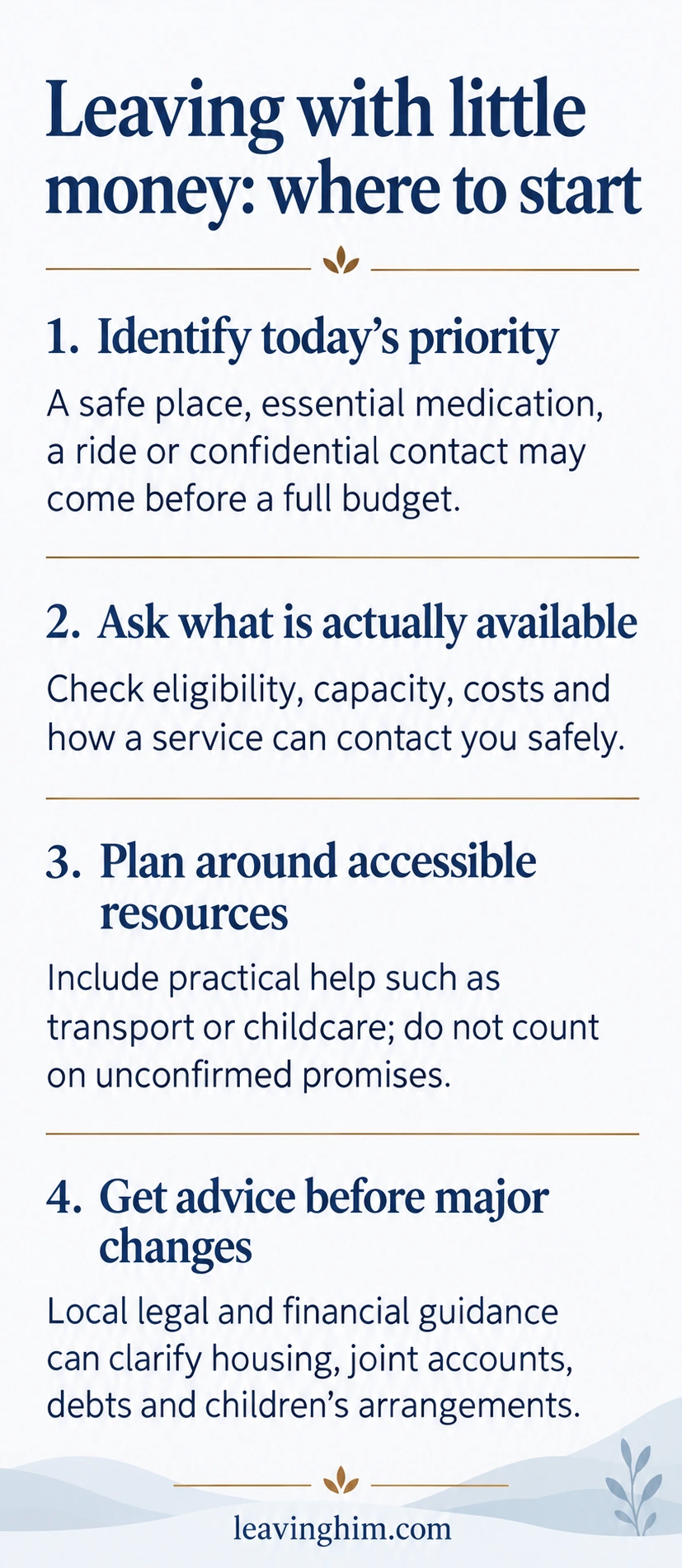
- Identify today’s priority. A safe place, essential medication, a ride or confidential contact may come before a full budget.
- Ask what is actually available. Check eligibility, capacity, costs and how a service can contact you safely.
- Plan around accessible resources. Include practical help such as transport or childcare; do not count on unconfirmed promises.
- Get advice before major changes. Local legal and financial guidance can clarify housing, joint accounts, debts and children’s arrangements.
Start with the most urgent need
Identify what cannot safely wait: a place to sleep, medication, food, transport or help for a child. You do not need a complete budget before asking a suitable service about that need. In immediate danger, seek local emergency help when you can do so safely.
If there is abuse or controlling behaviour, planning needs to account for the risk of a partner discovering your intentions. The U.S. Office on Women’s Health guide discusses support before and after leaving. Your circumstances may differ from someone who has savings, transport or nearby family; build around the options available to you.
Choose a safer way to ask for help
Consider who can see your device, email, shared accounts, call history or location. Private browsing does not make a monitored device safe. The National Domestic Violence Hotline’s internet-safety guidance explains these concerns.
If monitoring is possible, discuss safer contact with an advocate before making noticeable changes to passwords or shared access. A trusted person’s device or an in-person conversation may be an option, depending on your circumstances. Agree on the return contact too: “Please do not leave voicemail or send mail. Can I call you back tomorrow?”
Ask a service what it can actually provide
You can begin simply: “I am thinking about leaving and do not have money of my own. I need to understand housing and essential support.” Ask about confidentiality before sharing details you are concerned about disclosing.
In the United States, people experiencing abuse can contact the National Domestic Violence Hotline at 800-799-7233 or text START to 88788, when safe to do so. It offers support, safety planning and referrals rather than direct cash assistance. Local services elsewhere have different contact routes and provision.
If a service cannot help with your need, ask which organization can, whether you need a referral and how to reach it safely. Confirm costs, eligibility and availability instead of relying on a general promise of help.
Separate today’s needs from later costs
Think in small time periods rather than trying to price an entirely new life at once.
- Today: a safe place, essential medication, food, a journey and a way to communicate.
- This week: care arrangements, appointments, basic clothing and hygiene items.
- Later: ongoing housing, utilities, income, debt and other responsibilities.

These are prompts, not a checklist you must finish before getting help. Put “unknown” beside a cost you cannot estimate, and turn it into a question for a suitable service.
Check which resources are safely accessible
List income, savings, benefits, transport and practical help you can actually use. Distinguish confirmed support from an offer you have not discussed. A friend may be able to provide a ride or childcare even if they cannot lend money.
Shared accounts, notifications, statements and mailing addresses can affect privacy. Ask a bank about its procedures and consider specialist support if financial abuse is involved. Do not assume opening a separate account automatically keeps every trace private.
Before major changes to joint money, property or debt, get independent advice suited to your location when possible. A general article cannot establish your ownership rights or financial obligations.
Ask specific housing questions
For a shelter or temporary-housing program, ask about current space, eligibility, costs, length of stay, accessibility, children and pets. If it is full, ask about alternatives and how to check again safely. Availability is not guaranteed.
If someone offers a place to stay, clarify how long, who else lives or visits there, whether the address can remain private and whether it works for transport, work and care needs. A kind offer may still be unsuitable.
Where possible, get local advice about a lease, mortgage or jointly owned home before giving it up. Urgent safety needs may come first; a partner’s account of your rights should not be your only source of information.
Collect information without risking your safety
Identification, medication details, benefits information, banking records and housing documents may be useful. What is needed varies. Only obtain and store copies when it is safe and lawful; do not put yourself in danger to retrieve paperwork.
A photograph uploaded to shared cloud storage may be visible to someone else. Discuss a suitable storage option with an advocate if privacy is a concern. If documents are missing, ask the relevant service about replacements and application alternatives.
The Hotline’s preparation guidance can help you identify questions for an individual plan. It is not a list you must complete to deserve support.
Include children and other care needs
Ask about children’s safety, school, transport and care, as well as any disability support or other dependent-care responsibilities. Mention pets when exploring housing. These needs belong in the plan even when another issue feels more urgent.
Moving children, especially across borders, can involve existing arrangements and local law. Seek advice appropriate to your circumstances. Where threats or coercion are involved, ask a specialist about safer arrangements rather than assuming ordinary cooperation will be safe.
Children should not carry adult planning responsibilities, collect money, confront a parent or protect you. Specialist support can help with age-appropriate safety conversations.
Explore benefits, work and community support
Ask local providers about food, emergency assistance, benefits, childcare, employment services or help with bills. Check eligibility, documentation, waiting periods and whether you can apply while still sharing an address with your partner.
If you work, a suitable workplace contact may be able to discuss leave, scheduling or a safe contact route. Ask about confidentiality and available policies before sharing sensitive details. Support and legal entitlements vary.
Employment can be part of a longer plan, but it does not necessarily resolve an urgent housing or safety need. You do not need to treat getting a job as the only acceptable first step.
Make requests that people can answer
A specific request can be easier to respond to than “I need help.” For example: “Could you drive me to an appointment on Tuesday?” or “Could you sit with me while I call the housing service?” Confirm whether the person can help and whether the arrangement is safe.
If someone offers money, clarify whether it is a gift or a loan, when repayment is expected and whether conditions apply. Help should not give another person control over your relationships, location or decisions. You can decline an offer that creates new pressure.
An illustrative example: one question at a time
Imagine Jessica, who is considering leaving but cannot afford a housing deposit. She begins with a private conversation with a local advocate about safety and housing questions. She asks a friend whether rides to appointments are possible, without assuming the friend can also offer accommodation.
Jessica then asks a benefits service what documents are needed and how it can contact her privately. Some questions remain unanswered, so she identifies what to ask next instead of counting on unconfirmed help.
Jessica is fictional. The example illustrates a sequence of questions, not resources everyone can access or a promised outcome.
If you cannot leave yet
Staying for now does not mean accepting mistreatment or failing. Money, housing, disability, care responsibilities, fear and other barriers can limit the options available.
You can still seek private support and discuss ways to reduce risk while staying. An individual safety plan may address escalating situations, safe contacts and access to essential care. Review it when circumstances change.
Progress is not measured only by moving out. Reliable information or a safer contact route may matter today. You do not owe anyone a dramatic departure to prove that your concerns are serious.
Choose the next question to answer
Try: “The question I most need answered today is where I can sleep safely,” or “I need to know how a service can contact me privately.” Then identify a person or organization equipped to answer it.
The call-question tool below can help you prepare. It does not send your answers to a service or arrange support. Keep any notes only where appropriate for your circumstances. You can begin with one useful conversation and revisit the plan as you learn more.
Prepare questions for a resource call
Choose the need you want to ask a service about. No personal details are required here.
Availability is not guaranteed. If monitoring or abuse is possible, consider a safer device and private specialist support; this page cannot hide your browsing activity.
Use the questions and examples in the article above; the draft builder needs JavaScript.
15 questions readers ask
1. What if I have no money to leave?
Start by asking a suitable local service about safety, housing and essential needs. You do not need a complete budget before seeking help.
2. Do I need to save a particular amount first?
There is no universal amount. Urgent danger should not wait for a savings target, and practical costs depend on your circumstances.
3. Can I ask for help if I am still living with my partner?
Yes. Ask what support is available and how to communicate privately while you remain at the same address.
4. Does the U.S. National Domestic Violence Hotline give cash?
The Hotline offers support, safety planning and referrals, rather than direct cash assistance. Ask local services about any financial programs and their eligibility.
5. How can I contact a service privately?
Consider who can see your device, accounts, call history and location. If monitoring is possible, discuss safer contact with an advocate before making noticeable changes.
6. Is private browsing enough on a monitored device?
No. Private browsing does not make a monitored device safe. Another device or an in-person route may be more appropriate, depending on your situation.
7. Will a shelter automatically have space?
No. Ask about current capacity, eligibility, accessibility, children, pets and alternatives if there is no space.
8. Should I empty a joint account?
Do not rely on a general article for that decision. Ask about legal, financial and safety consequences before major account or property changes when possible.
9. What if I cannot get my documents?
Do not risk your safety to collect paperwork. Ask a relevant service how replacement documents or applications can be handled.
10. How can friends help without lending money?
They may be able to offer a ride, childcare, storage or company during a call. Confirm what they can actually provide and whether it is safe.
11. What should I ask about offered financial help?
Clarify whether it is a gift or loan and whether conditions apply. Support should not transfer control of your decisions to someone else.
12. Can I take my children to another city or country?
Get advice about safety, applicable law and existing arrangements. A general article cannot resolve relocation or parenting rights.
13. Should my children help hide the plan?
Children should not carry adult planning responsibilities, collect money or confront a parent. Ask a specialist about age-appropriate safety support.
14. What if I cannot leave yet?
You can still seek support and plan for safety while staying. Not moving out immediately does not mean accepting abuse or failing.
15. What is one manageable first step?
Name the most urgent unanswered question, then identify a safe person or service equipped to answer it. Confirm how they may contact you.