

A friends-with-benefits arrangement generally describes a friendship that includes sexual contact without an agreement to be romantic partners. The label alone does not tell you whether you are exclusive, how much contact you want or what happens if feelings change.
For adults considering this arrangement, the useful starting point is a freely chosen conversation about expectations. Either person can decline, change their mind or decide that another kind of connection would suit them better.
Check that the arrangement matches your wishes
Ask whether you want this connection as it is, rather than accepting it mainly in the hope of earning a romantic commitment later. Wanting romance, wanting a casual connection and wanting friendship without sex are all preferences you can state honestly.
Neither person owes sexual contact to keep a friendship. If your wishes differ, you can decline the arrangement without proving that either person is wrong. An agreement made to avoid losing someone may need more space and less pressure.

Keep consent specific and ongoing
A previous encounter or an ongoing arrangement is not permission for the next activity. Ask, listen and stop if the other person withdraws agreement or seems unsure. Silence and a lack of resistance do not establish consent.
RAINN explains consent as clear, voluntary and free from pressure. A person must be able to choose; someone who is asleep or too intoxicated to make that choice cannot consent. Either person can change their mind at any point, including after meeting up or beginning an activity.
Discuss exclusivity instead of assuming it
“Friends with benefits” does not automatically mean that either of you is seeing other people, or that you have agreed to exclusivity. Ask directly about the agreement you each want and what you will do if that changes.
Distinguish relevant information from unrestricted access to someone’s private life. You can discuss changes that affect sexual-health decisions without demanding third parties’ messages, photographs or intimate details. If you cannot agree on an arrangement you both want, you can stop.
Talk about sexual health before relying on assumptions
Discuss testing, barriers and what information you need before sexual contact. Many sexually transmitted infections have no symptoms; a person’s appearance or reassurance that they feel well cannot establish their status. The CDC prevention guide describes ways to reduce risk, and a healthcare professional can advise on testing for your circumstances.
If pregnancy is possible, include contraception in the conversation. The NHS contraception guide explains the available methods and factors to consider. Be clear about what you have agreed to use; do not substitute a casual label for a health discussion or treat any precaution as a guarantee.
Agree on everyday boundaries and privacy
Discuss messages, overnight stays, time together outside sex and how you want to describe the connection to others. One person may enjoy frequent affectionate contact while the other expects occasional meetings. It is better to discover that difference than to rely on an unwritten rule.
Keep private material private. Permission for an encounter does not include permission to record it, share a photograph or disclose intimate details to mutual friends. Ask before sharing information about the arrangement, and consider whether your expectations can coexist comfortably.
Make room for changing feelings
Affection may deepen, fade or stay much the same. A change is a reason to talk, rather than evidence that someone has failed at being casual. Try: “I am starting to want a romantic relationship. Is that something you want too?”
Take the answer seriously. You do not have to suppress your feelings to preserve access, and the other person does not owe romance because you have become attached. If you want different things, a pause or an ending may be more workable than continuing an arrangement you no longer want.
Let either person end sexual contact
Either person can stop, without a final encounter or a requirement to provide an explanation that the other person accepts. Where it is safe, communicate clearly about any cancelled plans and the contact you want afterward.
Friendship may continue, need distance or end. A smooth return is not guaranteed, and neither person owes it. Consider friendship when feelings are unequal if remaining friends would keep one of you waiting for something else.
Use a short check-in that leaves room for no
Before continuing, ask: “Do we both still want this? Are our agreements clear? Is there anything either of us wants to change?” Make it possible to answer honestly without losing an argument or being pressured to reassure the other person.
If a boundary is ignored, focus on what you need next rather than making a more elaborate rule to persuade someone to respect it. Clear communication can identify a mismatch; it cannot guarantee that an arrangement will suit both people indefinitely.
Read the infographic in text
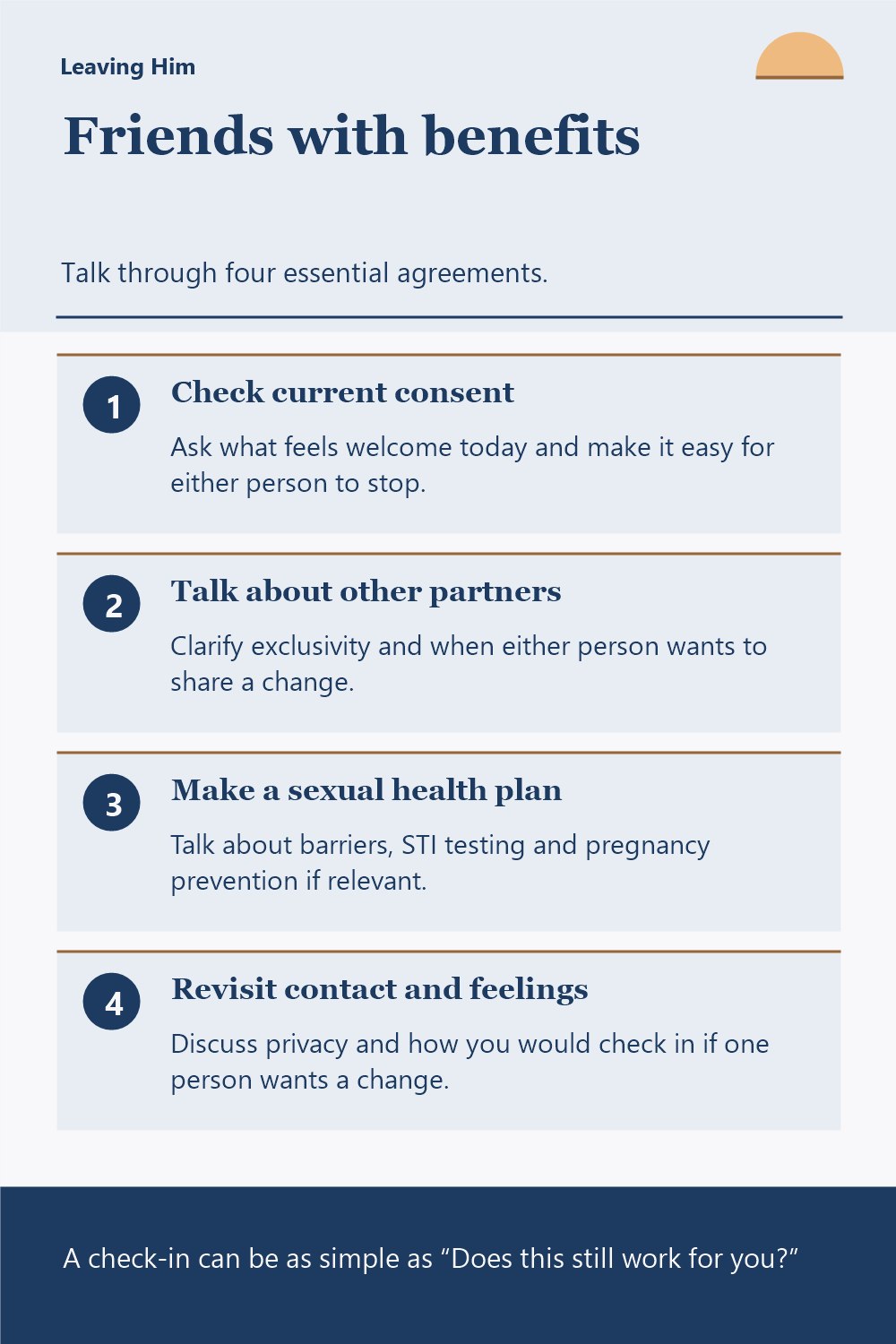
Friends with benefits
Talk through four essential agreements.
- Check current consent Ask what feels welcome today and make it easy for either person to stop.
- Talk about other partners Clarify exclusivity and when either person wants to share a change.
- Make a sexual health plan Talk about barriers, STI testing and pregnancy prevention if relevant.
- Revisit contact and feelings Discuss privacy and how you would check in if one person wants a change.
A check-in can be as simple as “Does this still work for you?”