

Discovering infidelity can leave you deciding what happened, what you need now and whether you want to continue the relationship. You do not have to choose immediately, and you do not have to attempt reconciliation before deciding to leave.
Some people want to explore repair; others do not. Consider the behaviour you can observe, your own wishes and any practical or safety concerns, rather than a prediction that every person who cheats will behave the same way.
Reconciliation is a choice
You can decide that infidelity crosses a limit for you, even if your partner wants another chance. Forgiveness, continued contact and remaining a couple are separate decisions. You do not owe a counselling course, retreat or trial period before leaving.
If you are unsure, take the time and support you need where that is safe. Considering repair does not commit you to staying, and deciding to leave does not mean you have failed to care enough. For another perspective, read questions to consider before forgiving a partner.

Look at current honesty
Continuing lies, concealed contact or repeated changes to an account can make it hard to decide on a shared future. Ask about information that matters to your choices, rather than trying to obtain every intimate detail of someone else’s involvement.
Unease alone is not proof of another affair. You can still say that the uncertainty is not workable for you. You do not need to access private accounts, track a partner or confront a third party to establish permission to leave.
Consider whether agreements are being respected
If you both chose to continue, what did you actually agree would change? Consider specific behaviour and follow-through: a conversation happens as agreed, a relevant boundary is respected or a known problem continues.
A promise is not the same as an observable change. Repeatedly ignored agreements can be a reason to stop trying, but a past affair does not give you a reliable formula for predicting every future action. Decide what you are willing to continue with now.
Notice blame, pressure and responsibility
Problems in the relationship can be discussed without making you responsible for a partner’s decision to break an agreement. Neither insufficient attention nor a disagreement makes infidelity your fault.
Notice whether the person can acknowledge their choice without demanding immediate forgiveness, minimizing the impact or blaming you for asking a question. You can set a limit on repeated arguments and decline a conversation that becomes insulting or threatening.
Explore repair only if you want it
If you both want to try, discuss what rebuilding trust would mean in practical terms and whether the changes are acceptable to each of you. Ongoing surveillance is not a substitute for an agreement both people can live with.
Counselling may be an option you freely choose; it is not a prerequisite for a breakup or a guarantee of reconciliation. If you fear control or retaliation, seek private specialist support before considering joint conversations. The overview of infidelity, responsibility and relationship choices can help you frame further questions.
Attend to health and practical needs
If sexual exposure may have changed, speak with a healthcare professional about testing and precautions that fit your circumstances. The CDC testing guide explains that testing needs vary and infections may have no symptoms. Ask about your own care rather than waiting for a partner to settle every uncertainty.
Consider immediate needs such as rest, someone trustworthy to talk with and enough information to manage shared bills or housing. Avoid major irreversible decisions made solely to punish the other person. Keep necessary records and get appropriate local advice about shared responsibilities.
Plan an ending around your circumstances
You may need arrangements for a tenancy, finances, children or belongings. A written list of urgent tasks can keep those questions separate from whether your partner agrees with the breakup. If money is a barrier, the guide to leaving with limited money offers practical questions for planning support.
If threats, monitoring or retaliation are a concern, seek confidential help from a suitable local service using a safer way to communicate. You do not owe a private final confrontation. For emotional questions that may remain after an ending, see finding a way forward after a breakup.
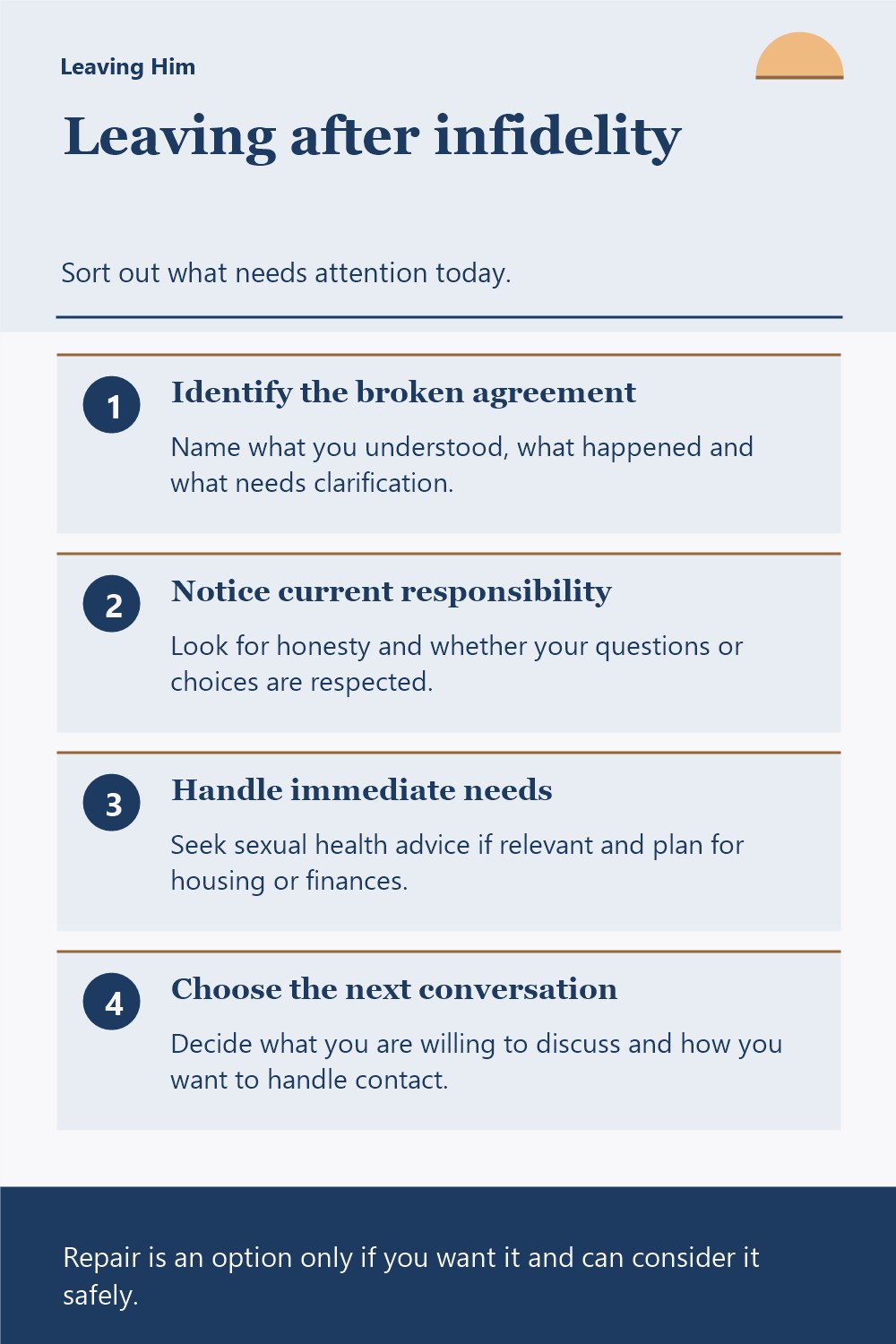
Read the infographic in text
Leaving after infidelity
Sort out what needs attention today.
- Identify the broken agreement Name what you understood, what happened and what needs clarification.
- Notice current responsibility Look for honesty and whether your questions or choices are respected.
- Handle immediate needs Seek sexual health advice if relevant and plan for housing or finances.
- Choose the next conversation Decide what you are willing to discuss and how you want to handle contact.
Repair is an option only if you want it and can consider it safely.