

If your partner is in contact with an ex, mentions a past relationship or keeps an old possession, you may wonder what it means for your relationship. Those details can raise a question, but they cannot reliably tell you what someone feels or intends.
A more useful starting point is the present relationship: what have you agreed, what is happening now, and how does your partner respond when something matters to you? You can ask for clarity without turning every memory or friendship into evidence against them.
On this page
Separate an observation from a conclusion
A person may still feel hurt, angry or disappointed about a past relationship. That does not automatically establish that they want it back. Listen to what they say about their present choices, while noticing whether repeated conversations leave room for your relationship too.
Familiar places can have many meanings. Returning to a restaurant or park is not, on its own, proof that you are a replacement for an ex. If a place feels uncomfortable to you, explain the concern and suggest choosing somewhere together.
Try writing down the specific event and the question it raised. “They cancelled our plan after a call” is an observation. “They will always choose their ex” is a conclusion that needs more information. The distinction can help you begin a clearer conversation.

Ask about contact and practical ties
People may remain in contact after a breakup for parenting, shared work, friendship, a wider social group or other reasons. Contact itself does not establish disloyalty. What matters for your relationship includes honesty and whether the contact fits the agreements you have made.
An old possession may need returning, belong to your partner or simply have been left in a cupboard. Ask about it without assuming that keeping it proves an affair or an inability to move on. You can discuss the use of a shared space separately from deciding what someone is allowed to remember.
Keep the question relevant to your own relationship. You do not need every detail of your partner’s past, and an ex’s private information should not become the price of reassurance.
Talk about what feels respectful now
Following an ex on social media is not a reliable test of remaining romantic feelings. Instead, talk about specific online behaviour that affects your agreements, such as flirtatious messages, public comparisons or contact that has been deliberately concealed.
Choose one issue for the conversation. You might say, “When our evening was cancelled without an explanation, I felt uncertain. Can we talk about how we handle changes to plans?” That gives your partner something concrete to answer.
The love is respect guide to boundaries and expectations explains why partners need to discuss expectations rather than assume they share them. A previous relationship’s rules do not automatically become this relationship’s agreements.
Decide what each of you is willing to offer. An agreement might concern how you communicate a change of plan or what exclusivity means to both of you. Constant phone searches or location checks are not substitutes for an agreement you can both choose freely.
Notice the quality of your relationship
If you feel little emotional connection, describe what is missing: time together, interest in your life, support or clarity about commitment. Those needs deserve attention regardless of whether an ex is involved. You do not have to prove that someone else is the cause before raising them.
Repeated comparisons can be hurtful, including comparisons presented as compliments. You can ask your partner to discuss your relationship on its own terms: “Please tell me what you want with me without comparing me to someone else.”
Look at the response over time. Do they answer a reasonable question, acknowledge a hurtful comment and follow through on an agreement? Or does the same issue keep returning without a willingness to address it? One conversation may not resolve everything, but it can show what each person is prepared to work on.
Choose from the information you have
You may still have uncertainty after talking. Consider whether you have enough honesty, care and compatibility to continue at a pace that feels comfortable. You can slow down, seek support or end a relationship without obtaining a complete account of someone else’s feelings.
If both of you want help discussing a recurring issue and feel safe participating, a qualified relationship professional may help structure the conversation. Their involvement does not guarantee a particular outcome.
If questions lead to threats, intimidation or control, prioritise confidential individual support rather than trying to force a joint discussion. Your choices can be based on the behaviour you experience now, even when its explanation remains unclear.
Clarify one shared obligation
If contact with an ex concerns a shared pet, ask who arranges care and when changes might affect your evenings. Tell your partner what would help you plan your time without asking to read their messages. Agree how to discuss changes that affect you both.
Read the infographic in text
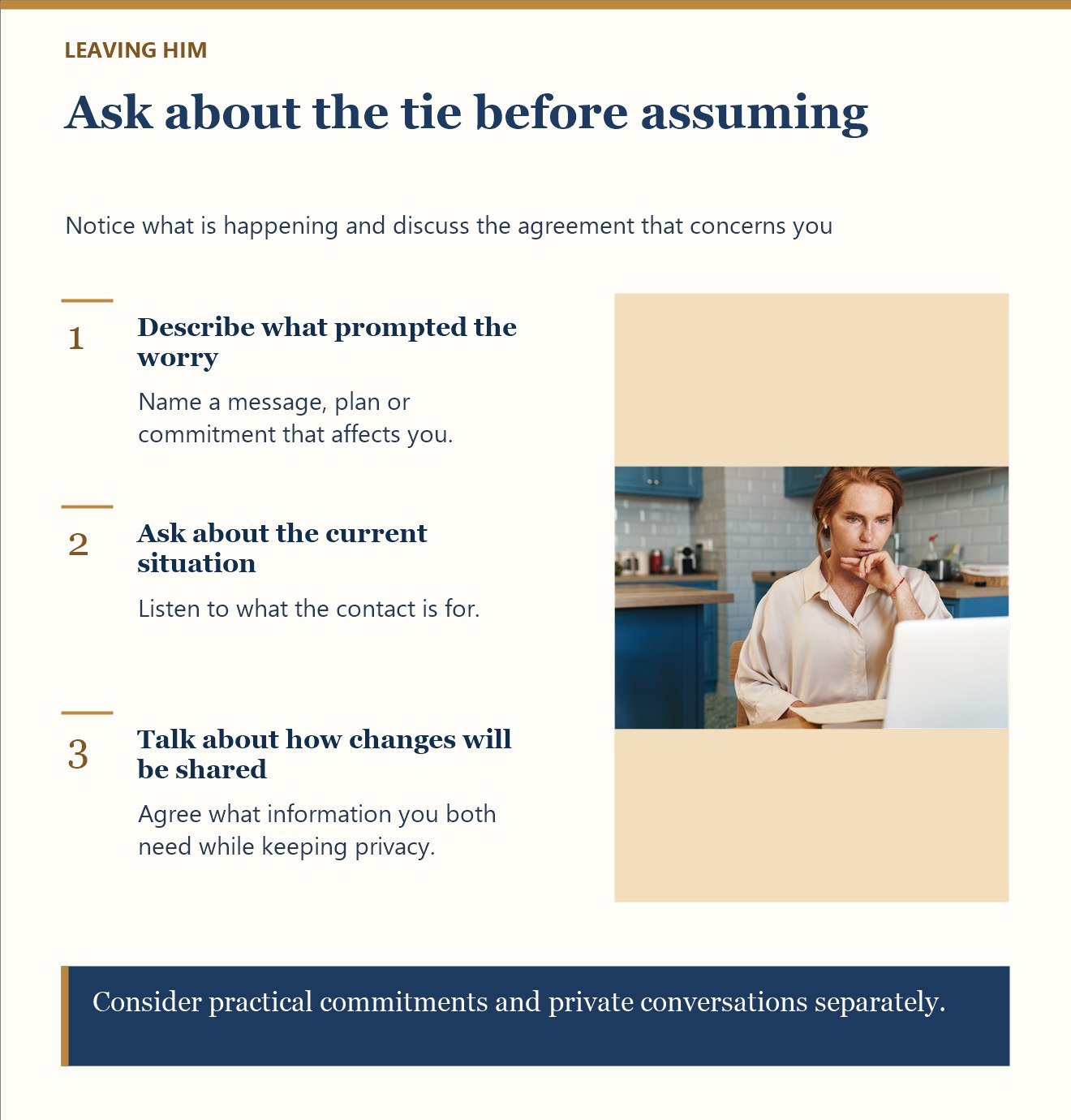
Ask about the tie before assuming
Notice what is happening and discuss the agreement that concerns you
- Describe what prompted the worry Name a message, plan or commitment that affects you.
- Ask about the current situation Listen to what the contact is for.
- Talk about how changes will be shared Agree what information you both need while keeping privacy.
Consider practical commitments and private conversations separately.